Sabtu, 24 Maret 2012

Syrian tanks enter northern town, Homs pounded again


BEIRUT (Reuters) - Syrian forces pounded the battered city of Homs with tank and mortar fire and troops pummeled several other rebel strongholds on Saturday, leaving at least 24 dead, opposition activists said.
With the bloodshed showing no signs of abating, the U.N.-Arab League peace envoy for Syria, Kofi Annan, flew to Moscow, seeking Russian backing for his efforts to secure a ceasefire.

Western and Arab states want Syrian President Bashar al-Assad to stand down but Russia, a long-time ally of Syria, has put the onus on the armed rebels and their foreign backers to make the first move.
In a statement ahead of Sunday's meeting between Annan and Russian President Dmitry Medvedev, the Kremlin said it would be hard to enforce a halt to the violence "until external armed and political support of the opposition is terminated".
More than a year after the start of the uprising against Assad, the prospect of a negotiated peace seemed more remote than ever, with clashes reported in numerous locations.
At least 10 people were killed by explosions and sniper fire in Homs, the epicenter of the anti-Assad revolt, said activists who accused Syrian forces of shelling residential areas in the centre of the city indiscriminately.
"The shelling started like it does every morning, for no reason. They are using mortar and tank fire on many neighborhoods of old Homs," an activist in Homs's Bab Sbaa district told Reuters via Skype.
He said most residents in the area had fled to safer districts and many were trying to escape the city altogether.
The Syrian government says rebels have killed about 3,000 members of the security forces and blames the violence on "terrorist" gangs. The official Sana news agency said the bodies of 18 "army martyrs", killed in various clashes, were buried on Saturday.
REBELS UNDER FIRE
Syrian troops have repeatedly targeted Homs, Syria's third largest city, and said last month they had regained control of Baba Amr, a large neighborhood held by rebels for several months. However, a surge in violence in other neighborhoods this week suggested the army was struggling to keep control.
The Homs activist, who declined to be named for fear of reprisals, said the opposition Free Syrian Army had also not been able to reestablish its hold on parts of the city.
"The Free Syrian Army had been in Bab Sbaa when the army started shelling the area four days ago and they weren't able to block the army raids because they were getting hit by mortars at the same time that armored vehicles were coming in," he said.
"We only have a few rebels here left. There is nothing they can do," he added.
It was impossible to verify the reports independently. Syrian authorities have prevented foreign journalists and human rights workers from entering affected areas.
Further to the north, security forces killed at least five people and wounded dozens more in raids on Saraqib, which lies in Idlib province bordering Turkey, activists said.
"There are dozens of tanks and armored vehicles storming Saraqib now and there is heavy artillery fire," an activist called Manhal said via Skype.
Mortars and heavy artillery fire also hit the city of Qusair, in Homs province, killing three civilians. There were reports of overnight clashes in the city of Douma, close to the capital Damascus.
In the southern province of Deraa, birthplace of the revolt, the Syrian Observatory for Human Rights said a man was shot dead at a checkpoint in an area where a soldier had been gunned down. Three other soldiers were killed in an attack in the northeastern province of Hasaka, it said.
RUSSIAN COMPLAINTS
Deep divisions within opposition ranks have weakened the anti-Assad front. In a bid to tackle the problem at a military level, a senior army defector said on Saturday that all rebel groups would work under the leadership of the Free Syrian Army.
"In these critical times that our beloved Syria is passing through, it is necessary that all noble people of this nation work to unite all efforts at toppling this corrupt regime," Brigadier General Mustafa Sheikh said in a video message.
Sheikh said he would head the group's military council while FSA leader Colonel Riad al-Asaad, who was sitting alongside him, would take charge of the fighting forces.
Annan is leading international efforts to avoid any escalation and has drawn up a six-point plan, including demands for a ceasefire, the immediate withdrawal of heavy armor from residential areas and access for humanitarian assistance.
The EU and other bodies have also imposed sanctions to put pressure on Assad and his allies. The bloc added two state-owned oil companies - Syrian Petroleum Company and Mahrukat Company - to its list of organizations facing sanctions on Saturday, a day after it banned Assad's wife from travelling to the EU or shopping with European companies.
But attempts to halt the conflict have been stymied by divisions between world powers. Russia and China have vetoed two U.N. resolutions highly critical of Damascus.
Moscow and Beijing did support a Security Council resolution earlier this week endorsing Annan's mission. The former U.N. chief is due to fly to China after his Russia talks.
Moscow has accused the West of being too one-sided in the conflict, arguing that outside support for rebels is fuelling the fighting in Syria, which hosts a Russian naval base.
(Additional reporting by Alexei Anishchuk and Steve Gutterman in Moscow; Writing by Crispian Balmer; Editing by Mark Heinrich and Andrew Heavens)

Label:

Kamis, 22 Maret 2012

Mali rebels advance in north, mutineers seek president


BAMAKO, March 23 (Reuters) - Tuareg rebels in northern Malipushed south to occupy positions vacated by government forces, sources said, as mutinous soldiers in the distant capital sought to complete a coup by arresting the president.
The MNLA rebels were approaching towns in the desert north, apparently taking advantage of the confusion created by a coup attempt in the capital Bamako by low-ranking soldiers angry at thegovernment's handling of the uprising.

By late on Wednesday, the mutinous soldiers had over-run the presidential palace, were in control of state television and roamed the streets of Bamako. But President Amadou Toumani Toure's whereabouts were still unconfirmed, officials said.
Mali, which was flooded with men and weapons after Libya's civil war, was being rocked by crises - including the Tuareg-led rebellion, a growing Islamist threat and a food crisis - well before the soldiers mutinied.
A Malian officer in the northern town of Kidal said rebels had occupied the military camp in Anefis, 100 km (60 miles) to the southwest, after government forces withdrew.
"The army has pulled back to Gao," a source in Timbuktu, another main town in the north, told Reuters, asking not to be named. "There is no longer any military leadership. (The rebels) will take the towns in the north," he said.
The MNLA rebels, whose numbers have been swollen by Malian Tuareg returning from the ranks of Libya's army, have been fighting since mid-January for an independent north. They have pushed government soldiers out of remote towns but had not yet threatened the regional capitals of Kidal, Timbuktu and Gao.
Rebels pledged on Thursday to take advantage of the chaos as senior civilian and military officials in northern regions were arrested by mutinous soldiers.
Sporadic gunfire rang out in Bamako late on Thursday and the streets were largely deserted but mutinous soldiers moved around the capital on trucks, motorcycles and on foot.
PROTECTED
The exact whereabouts of Toure, who has overseen a decade of relative stability, are unknown but officials in his camp and diplomats said they believed he was being protected by a pocket of loyalist soldiers.
Mutinous soldiers said they would launch an attack on the parachute regiment they believe is protecting the president.
"We will finish it this evening," said one soldier at an abandoned fuel station in the city.
Toure, 63, a former paratrooper who seized power in 1991, had gained the nickname "Soldier of Democracy" in his West African state and had been preparing to cede power in April after an election.
Mali's neighbors, the United Nations and world powers from Paris to Washington called for a return to constitutional rule. The regional decision-making body ECOWAS Commission said it would not recognize the junta.
The 7,000-strong army has for weeks sought better weapons to fight the rebels.
Captain Amadou Sanogo, president of the newly formed National Committee for the Return of Democracy and the Restoration of the State (CNRDR), said the poor handling of the crisis in the north was mostly to blame for the coup.
Speaking to pan-African television station Africable, Sanogo, who said he received training from U.S. Marines and intelligence, pledged not to remain in power but refused to give a timeframe for restoring civilian rule.
"Three months, 6 months, 9 months, it will depend on the structure that we put in place for me to go back to being a soldier. Someone else will do the rest," Sanogo said.
"We have come asking for decent living conditions and to be treated well ... we will fight for this," he added.
Restoring state authority to the north was the priority, he said. But, amid reports of arrests of ministers and other senior government officials, Sanogo implied that those detained would face trial for alleged crimes.
"We are not killers. I am not a killer. But the moment was right and everyone will have to face charges before the appropriate authority," he said.
(Writing by David Lewis and Bate Felix; Editing by Janet Lawrence)

Label:

Clashes across Syria despite U.N. ceasefire call


BEIRUT (Reuters) - More than 40 people died in clashes acrossSyria on Thursday, opposition activists said, as a U.N. Security Council call for an immediate end to the fighting fell on deaf ears.
In the worst incident 10 civilians, including three children and two women, died when their small bus was shot up in the northern town of Sermeen as they tried to flee to Turkey, the British-based Syrian Observatory for Human Rights (SOHR) said.

The SOHR, which depends on a network of local contacts for its information, said it was not clear who was behind the killings. Other activists blamed the Syrian army, which has been trying to stamp out insurgents in the area.
Dozens of civilians were killed in other parts of the northern province of Idlib, in Homs, Hama and Deraa in the south of the country, it said. Five rebel gunmen and seven soldiers were killed in clashes in Homs province, it added.
U.N. Secretary General Ban Ki-moon said Wednesday's unanimous Council statement had sent a clear message to Syria to end all violence, but Damascus appeared to dismiss the document, which is not legally binding.
At least 8,000 people have died in the year-long revolt against President Bashar al-Assad, according to U.N. figures issued a week ago, with a motley assortment of fighters grouped in the rebel Syrian Free Army taking on the security apparatus.
Syrian Foreign Ministry spokesman Jihad Makdesi said this week that 3,000 members of the security forces had died in the uprising, which Damascus blames on terrorist gangs.
Heavily armed government forces have made advances in recent weeks, sweeping armed opponents from strongholds around Syria, but they appear to be struggling to consolidate their gains.
Opposition sources said tanks had once again shelled a neighborhood in the northeastern city of Hama, which has been a centre of revolt. Opposition sources said at least 20 people had died in army attacks there in the last 48 hours.
It is impossible to verify reports from Syria because authorities have denied access to independent journalists.
AMBUSHES
Syrian troops also turned heavy guns on Sermeen.
"Syrian forces are still not able to get inside the town because of fighting, but they are shelling Sermeen and using heavy machineguns," said SOHR head Rami Abdelrahman.
In addition, the SOHR reported heavy fighting in al-Qusair, a town close to the Lebanese border. Three residents died in the fighting and four soldiers were killed in an ambush.
Fighting also erupted in southern Deraa, he said, and Assad's forces conducted raids in the eastern province of Deir al-Zor and coastal Latakia province to try to snuff out the rebellion.
The Security Council's statement was supported by Russia and China, which had both vetoed previous Council resolutions, marking a rare moment of global unity over the crisis.
It backed a peace drive by U.N.-Arab League envoy Kofi Annan, calling for a ceasefire, political dialogue and full access for aid agencies. It also says the army should stop using heavy weapons in populated areas and pull troops back.
Turkish Foreign Minister Ahmet Davutoglu said world powers needed to work together much harder to end the bloodshed, saying the Council statement was just "a common message".
"We also need to work out a common action plan," he told reporters during a visit to Vienna on Thursday.
The U.N. statement talks of the need for political transition in Syria but does not demand that Assad step down - something both the rebels and the Arab League have called for.
Syria's official news agency appeared to shrug off the document, saying it contained "no warnings or signals".
Diplomats say that without swift resolution, the conflict risks spilling over into neighboring countries and heightening already tense sectarian ties, with the uprising setting Assad's minority Alawite sect against a Sunni Muslim majority.
Underlining the dangers, several stray Syrian shells fell in the Lebanese border village of al-Qaa and nearby fields late on Wednesday, wounding one person, residents said. Gunfire could be heard in the border area again on Thursday.
MORE ABUSES
Human Rights Watch accused Syrian forces of using the same "brutal methods" in Qusair as it had during the siege of Homs.
"Having seen the devastation inflicted on Homs, the Russian government should stop arms sales to the Syrian government or risk becoming further implicated in human rights violations," said Sarah Leah Whitson, the group's Middle East director.
Russia has defended its long-standing military ties with Syria and has said it sees no reason to modify them.
The European Union is set to impose further sanctions on Assad's inner circle on Friday, including his wife Asma, who described herself as "the real dictator" in an email published by Britain's Guardian newspaper last week.
"Tomorrow we will decide on new sanctions, not only against the Assad regime but also against the people around him," German Foreign Minister Guido Westerwelle told Deutschlandfunk radio.
Referring to Moscow's support for the U.N. statement, he said: "Assad cannot depend on the protective hand of Russia in the violence against his own people and that could accelerate the process of erosion of the regime."
Although Russia has stuck to its demand that Assad must not be deposed by foreign powers, it has taken a sterner line this week, accusing the Syrian leadership of mishandling the crisis.
Analysts say this shows Russia is hedging its bets about Assad's fate and is positioning itself for his possible fall.
"Russia will not be focused on keeping Assad in power for the sake of keeping Assad in power," said Dmitry Trenin, director of the Carnegie Moscow Centre think tank.
Envoy Kofi Annan plans to go to Russia soon for talks on Syria, his spokesman said in Geneva on Thursday, but declined to be more specific.
British Foreign Secretary William Hague said international pressure on Syria would rise until there was a ceasefire.
"As long as this killing goes on we have to increase the pressure as well as consider what steps to take in the U.N. Security Council," he told a news conference in Rome.
Hague welcomed Chinese and Russian support for the U.N. statement, but added: "This does not mean it is immediately possible to agree on a Security Council resolution."
(Additional reporting by Khaled Yacoub Oweis in Amman, Steve Gutterman in Moscow, Steve Scherer in Rome and Madeline Chambers in Berlin; Writing by Crispian Balmer and Erika Solomon; Editing by Alistair Lyon and Tim Pearce)

Label:

Rabu, 21 Maret 2012

French police press besieged gunman to surrender


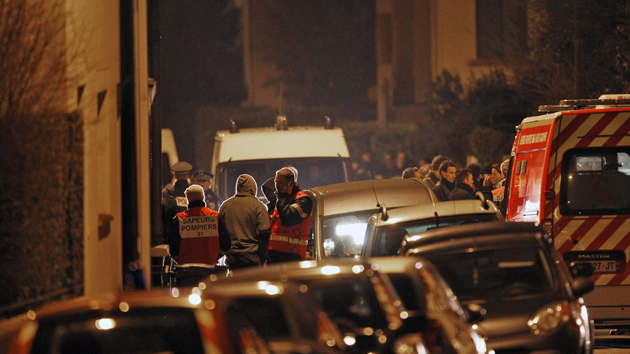
TOULOUSE, France (AP) — Riot police set off explosions outside an apartment building early Thursday in an effort to force the surrender of a gunman who boasted of bringing France "to its knees" with an al-Qaida-linked terror spree that killed seven people.
Hundreds of heavily armed police, some in body armor, surrounded the five-story building in Toulouse where the 24-year-old suspect, Mohamed Merah, had been holed up since the pre-dawn hours of Wednesday.


As midnight approached, three explosions were heard and orange flashes lit up the night sky near the building. An Interior Ministry official said the suspect had gone back on a previous pledge to turn himself in — and that police blew up the shutters outside the apartment window to pressure him to surrender.
Sporadic blasts and bursts of gunfire rang out throughout the night, though officials insisted no full-out assault was under way. "It's not as simple as that. We are waiting," the Toulouse prosecutor, Michel Valet, told The Associated Press.
Authorities said the shooter, a French citizen of Algerian descent, had been to Afghanistan and Pakistan, where he claimed to have received training from al-Qaida.
They said he told negotiators he killed a rabbi and three young children at a Jewish school on Monday and three French paratroopers last week to avenge the deaths of Palestinian children and to protest the French army's involvement in Afghanistan, as well as a government ban last year on face-covering Islamic veils.
"He has no regrets, except not having more time to kill more people and he boasts that he has brought France to its knees," Paris Prosecutor Francois Molins told a news conference.
French authorities — like others in Europe — have long been concerned about "lone-wolf" attacks by young, Internet-savvy militants who self-radicalize online since they are harder to find and track. Still, it was the first time a radical Islamic motive has been ascribed to killings in France in years.
Merah espoused a radical brand of Islam and had been to the Afghanistan-Pakistan region twice and to the Pakistani militant stronghold of Waziristan for training, Molins said.
He said the suspect had plans to kill another soldier, prompting the police raid.
The standoff began after a police attempt at around 3 a.m. Wednesday to detain Merah erupted into a firefight. Two police were wounded, triggering on-and-off negotiations with the suspect that lasted into the night.
As darkness fell, police cut electricity and gas to the building, then quietly closed in to wait out the suspect.
Authorities were "counting on his great fatigue and weakening," said Didier Martinez of the SGP police union, adding the siege could go on for hours. Street lights were also cut, making Merah more visible to officers with night vision goggles in case of an assault.
The gunman's brother and mother were detained early Wednesday. Molins said the 29-year-old brother, Abdelkader, had been implicated in a 2007 network that sent militant fighters to Iraq, but was never charged.
The siege was part of France's biggest manhunt since a wave of terrorist attacks in the 1990s by Algerian extremists. The chase began after France's worst-ever school shooting Monday and two previous attacks on paratroopers beginning March 11, killings that have horrified the country and frozen campaigning for the French presidential election next month.
French President Nicolas Sarkozy, who has played up nationalist themes in his bid for a second term, vowed to defend France.
"Terrorism will not be able to fracture our national community," Sarkozy declared Wednesday on national television before heading to funeral services for the two paratroopers killed and another injured last week in Montauban, near Toulouse.
The suspect repeatedly promised to turn himself in, then halted negotiations. Cedric Delage, regional secretary for a police union, said police were prepared to storm the building if he did not surrender.
After bouts of deadly terrorist attacks in France in the 1980s and 1990s, France beefed up its legal arsenal — now seen as one of the most effective in Western Europe and a reference for countries including the U.S. after the Sept. 11 attacks.
Sarkozy's office said President Barack Obama called him Wednesday to express condolences to the families of the victims and praise French police for tracking down the suspect. The statement said France and the United States are "more determined than ever to fight terrorist barbarity together."
In recent years, French counterterrorism officials have focused mainly on al-Qaida in the Islamic Maghreb, the North African affiliate of Osama bin Laden's network that has its roots in an insurgent group in Algeria, a former French colony.
Molins said Merah's first trip to Afghanistan ended with him being picked up by Afghan police "who turned him over to the American Army who put him on the first plane to France."
He said Merah bragged to authorities that he planned more attacks inside France.
"He had foreseen other killings, notably he foresaw another attack this morning, targeting a soldier," Molins said, adding Merah also planned to attack two police officers. "He claims to have always acted alone."
Merah has a long record as a juvenile delinquent with 15 convictions, Molins added.
An Interior Ministry official, speaking on condition of anonymity, said Merah had been under surveillance for years for having "fundamentalist" Islamic views.
During the standoff, police evacuated the five-story building, escorting residents out using the roof and fire truck ladders. The suspect's apartment was on the ground floor of the postwar building, locals said.
French authorities said Merah threw a Colt .45 handgun used in each of the three attacks out a window in exchange for a device to talk to authorities, but had more weapons, including an AK-47 assault rifle. Interior Minister Claude Gueant said other weapons had been found in his car.
"The main concern is to arrest him, and to arrest him in conditions by which we can present him to judicial officials," Gueant added, explaining authorities want to "take him alive ... It is imperative for us."
Delage said a key to tracking Merah was the powerful Yamaha motorcycle he reportedly used in all three attacks — a dark gray one that had been stolen March 6. The frame was painted white, the color witnesses saw in the school attack.
According to Delage, one of Merah's brothers went to a motorcycle sales outfit to ask how to modify the GPS tracker, raising suspicions. The vendor then contacted police.
The shooter has proved to be a meticulous operator. At the site of the second paratrooper killing, police found the clip for the gun used in all three attacks — but no fingerprints or DNA on it.
Those slain at the Jewish school, all of French-Israeli nationality, were buried in Israel on Wednesday as relatives sobbed inconsolably. The bodies of Rabbi Jonathan Sandler, his sons Arieh, 5, and Gabriel, 3, and 8-year-old Myriam Monsenego had been flown there earlier in the day.
At the funeral, Myriam's eldest brother, Avishai, in his 20s, wailed and called to God to give his parents the strength "to endure the worst trial that can be endured."
Palestinian Prime Minister Salam Fayyad denounced the deadly shooting attack at the Jewish school and condemned the link to Palestinian children.
"It's time for criminals to stop using the Palestinian cause to justify their terrorist actions," Fayyad said in a statement. "The children of Palestine want nothing but dignified lives for themselves and for all the children."
Before he was killed last year, bin Laden stressed the importance of focusing on the Palestinian cause. In what is believed to be a draft letter to al-Qaida's top lieutenant, the al-Qaida leader wrote about the need for the terror group's affiliates to tie their operations to broad concern for Palestine instead of local grievances, according to declassified documents obtained in last year's bin Laden raid that were reviewed by the Washington Post.

Label:

Senin, 19 Maret 2012

Ohio man not jailed for stopping Facebook apology


CINCINNATI (AP) — A man who made comments about his estranged wife on his Facebook page and was threatened with jail unless he posted daily apologies for a month won't be locked up even though he stopped making amends early.
Mark Byron agreed to begin posting the apology last month to avoid jail but later said the ruling violated his freedom of speech. He stopped posting the apology after 26 days, but Judge Jon Sieve, of Hamilton County Domestic Relations Court, determined Monday that he had posted it long enough, and Byron wasn't jailed.
Byron, of Cincinnati, said afterward that he was relieved not to be in jail, "but I was prepared to go to defend my free speech rights."

Byron's attorney, Becky Ford, said Monday that she has filed a notice of appeal in a state court.
"We believe that by scripting and saying what he had to post on Facebook, the court violated his rights to free speech," Ford said. "The First Amendment not only protects your right to speak, but it also protects your ability to remain silent."
According to the ruling, Byron, 37, had posted comments on his page in November, saying in part, "If you are an evil, vindictive woman who wants to ruin your husband's life and take your son's father away from him completely — all you need to do is say you're scared of your husband or domestic partner and they'll take him away."
The Byrons have been involved in ongoing divorce and child custody proceedings. Byron has said his wife and the court have prevented him from seeing his young son many times. The court maintains he is allowed to see him on a twice-weekly basis.
A June court order prohibited Byron from causing his wife physical or mental abuse, harassment or annoyance. She asked in December that he be found in contempt after learning of the Facebook comments.
Domestic Relations Magistrate Paul Meyers in January found Byron in contempt of a protective order because of his Facebook comments. He said Byron could avoid a 60-day jail sentence and a $500 fine by posting the apology — written by the magistrate — to his wife and all of his Facebook friends and paying her attorney fees. The same apology had to be posted every day no later than 9 a.m.
The ruling said several of Byron's comments were intended to "generate a negative and venomous response toward her from his Facebook friends."
Byron said Monday that, even if he didn't go to jail, "this is a really big deal" for hundreds of millions of people using Facebook.
"They could do this to anybody," he said.
Free speech and media experts have said that the case should concern other users of the social networking site.
Cincinnati attorney Jack Greiner, who specializes in free speech and media issues, said earlier that compelling speech through a court-written apology raises as many free speech concerns as prohibiting speech. He said Monday that the issue still causes concern but that he believes Byron might have difficulty appealing since he posted the apology and didn't go to jail.
The statement Byron posted had him apologizing to his wife for "casting her in an unfavorable light" and to his Facebook friends for "attempting to mislead them."
He says that in addition to standing up for his rights, he stopped posting the apology "because it forced me to make false statements."
The estranged wife's attorney, Joel Moskowitz, said he was disappointed that Byron did not get any jail time.

Label:

Minggu, 18 Maret 2012

Blast hits Aleppo; clashes and protests across Syria


BEIRUT (Reuters) - A car bomb ripped through a residential area of Syria's second city Aleppo on Sunday, as activists reported heavy clashes across the country between state forces and rebels fighting to overthrow President Bashar al-Assad.
World powers have been unable to stop more than a year of bloodshed in Syria, a country that sits on the fault lines of several regional and ethnic conflicts. Recent army gains against rebel positions have shown no sign of quelling the violence and no negotiated settlement is in sight.

In Aleppo, Syria's commercial hub, state news agency SANA said terrorists were behind the car bomb that killed two people and wounded 30 others when it exploded in a central area close to a state security office and a church.
Opposition activists accused the government of staging the explosion to back up its official line that foreign-backed extremists are behind the uprising. The government says about 2,000 members of security forces have been killed in the unrest.
The explosion came a day after twin blasts killed 27 people in the capital Damascus and wounded nearly 100 others.
Aleppo had seen less unrest than much of Syria but has recently been hit with more violence as revolt spreads and becomes increasingly bloody. The United Nations says more than 8,000 have been killed and humanitarian conditions are grim.
The semi-official news channel al-Ikhbariya said security forces had been tipped off about the bomb in Aleppo and had been moving residents out of the area when it went off. It said the car had been filled with 200 kilogrammes of explosives.
Pictures on the SANA website showed building fronts blasted open and aid workers standing near piles of shattered masonry and bomb craters, while Syria TV showed a street corner splattered in blood.
"The explosion came suddenly and the only thing I thought to do was fall to the ground," a girl told Syria TV, her hands and face covered in shards of glass. "Nothing remained. All the building fronts collapsed. God curse them."
No group claimed responsibility for the Aleppo attack, and an activist from the opposition's local Revolutionary Council said the government was behind the explosion.
"They want to make our uprising seem like a terrorist operation to the rest of the world, but it is not," said the activist called Marwan, who spoke to Reuters by telephone.
CLASHES, RAIDS ACROSS SYRIA
The Syrian Observatory for Human Rights said at least 19 people, including four children, had died in rocket and gunfire during army raids and fighting with rebels across the country on Sunday.
Fighting was heaviest in the northwestern province of Deir Ezzor, where activists said rebels had taken over some of the streets in the provinces main city and had torched at least two army vehicles. At least 14 soldiers and five rebels died in the fighting, which calmed by evening, the Observatory said.
In the southern province of Deraa, a sniper shot dead two men in Dael, the British-based Observatory said, and thousands took to the street to mourn the deaths and protest four decades of Assad family rule.
In northern Idlib, gunmen shot dead a Turkish lorry driver, Turkey's state-run Anatolian news agency said, but it did not specify when the attack took place.
Reports from Syria are difficult to verify as the government has restricted access to foreign journalists.
Aid groups also have limited access but were recently allowed a joint mission between staff from the Organization of Islamic Cooperation, the Syrian government and the United Nations. The group is now in Damascus planning the mission.
The head of the International Committee of the Red Cross Jakob Kellenberger was on his way to Moscow on Sunday to ask Russia to help persuade Damascus to let more humanitarian aid into the country.
PROTESTS, ARRESTS IN CAPITAL
In the capital, as hundreds gathered to mourn victims of Saturday's car bombs, activists said security forces beat and arrested people at a march of more than 200 when protesters began shouting "the people want to topple the regime".
The phrase has echoed through the wave of Arab uprisings that began last year and has toppled autocratic rulers in Tunisia, Egypt, Libya and Yemen.
"At first they shouted slogans against violence and the police didn't do anything, but as soon as they started to call for regime change the police rushed in and started beating people with canes," said Rami Abdelrahman, head of the Observatory.
The protest, which called for non-violent resistance to the government, had been led by moderate opposition leaders previously tolerated by the government because of their calls for dialogue and rejection of foreign intervention.
Activists said the Sunday march aimed to commemorate the peaceful roots of Syria's uprising, which has been overshadowed by a growing armed insurgency against state security forces.
Security forces beat and arrested Mohammed Sayyed Rassas, a leader of the National Coordinating Body for Democratic Change (NCB), an opposition group which had visited China and Russia in attempts to promote dialogue between Assad and the opposition.
Most opposition groups have rejected the NCB over its insistence on non-violence and its stance against foreign intervention, arguing the government's fierce crackdown has made arming the uprising inevitable.
Security forces also arrested Farzand Omar, a doctor and politician from the party "Building the Syria State," when he arrived at the Damascus airport from his hometown of Aleppo.
"His arrest confirms once again that Syrian authorities repress all their opponents and are dishonest in claiming that they respect and accept member of the Syrian opposition or accept dialogue," the party said in a statement.
Syrian government forces have crushed a rebel stronghold in the central city of Homs and have been pounding rebel strongholds in northern Idlib. Activists reported heavy clashes and extensive security force raids in the embattled province, which borders Turkey.
"It's clear that the battle is finishing in the regime's favor overall," said a Lebanese official close to Assad's government.
Rebels argue they are making tactical retreats and will continue to reappear whenever the army eases its grip, hoping to tire out Assad's forces.
"On the security level there is a long and difficult struggle for the regime and it is obvious this will take a long time to finish," the Lebanese source said. "We will see many more explosions like those we saw yesterday but in general they have finished off the military fight and they don't have much more to do."
(Additional reporting by Laila Bassam; Editing by Andrew Roche)

Label:

Sabtu, 17 Maret 2012

Soldier suspected in Afghanistan massacre to meet with lawyers


TACOMA, Washington (Reuters) - A lawyer representing the U.S. soldier implicated in the massacre of 16 villagers in Afghanistansaid on Saturday he and other members of the defense team would spend several days with him in the week ahead.
U.S. Army Staff Sergeant Robert Bales is in solitary confinement at a military detention center at Fort Leavenworth, Kansas, where he arrived late on Friday.

Bales, 38 and a four-tour combat veteran, is suspected of walking off his base in southern Afghanistan on Sunday and gunning down the 16 civilians, including nine children and three women, in a massacre that sent American-Afghan relations into a tailspin.
Bales, whose military unit is based south of Tacoma, Washington, had been held in Kuwait after he was flown out of Afghanistan on Wednesday. He has not yet been charged.
Bales' civilian attorney, John Henry Browne, said in a statement he was being joined in the defense effort by Emma Scanlan, also a civilian, and a military defense counsel, Major Thomas Hurley.
"Public reports that Sergeant Bales' supervisors, family and friends describe him as a level-headed, experienced soldier are consistent with information gathered by the defense team," Browne's statement said.
"It is too early to determine what factors may have played into this incident and the defense team looks forward to reviewing the evidence, examining all of Sergeant Bale's medical and personnel records and interviewing witnesses."
An unnamed U.S. official had told The New York Times the killings were a result of "a combination of stress, alcohol and domestic issues - he just snapped."
But Browne has refuted that, saying on CNN that marital problems were "totally bogus." He said his client had a "very strong marriage and, frankly, we're all taking offense at that."
FAMILY MOVED TO BASE
"Sergeant Bales' family is stunned in the face of this tragedy, but they stand behind the man they know as a devoted husband, father and dedicated member of the armed services," Browne's statement on Saturday said.
Bales' wife, Karilyn, and two young children have been moved into military lodging at Joint Base Lewis-McChord outside of Tacoma, Browne said earlier in the week.
Karilyn Bales works for a local business communications firm, a firm employee confirmed on Saturday.
Jill Heron, director of marketing and client relations for the firm, known as AMAXRA Inc., told Reuters Karilyn Bales is "a valued employee who works remotely" and remained employed by the company in Redmond, Washington.
Heron, visibly upset and nervous at her home in rural Carnation, outside Seattle, said she couldn't comment further.
Robert Bales, who completed a two-year associate college degree in 1992, joined the Army in 2001, the Army said in a statement late on Friday when it formally identified him for the first time since Sunday's incident.
His home of record was listed as Jensen Beach, Florida, although Browne has said Bales grew up in the Midwest.
His military training included education in sniper skills, military leadership and a course called "combat life savers."
The Army statement said Bales had spent a total of 37 months in three deployments in Iraq between 2003 and 2010.
BALES' HISTORY BEGINS TAKING SHAPE
Bales has had at least one previous minor run-in with the law, records show. In 2002, he was charged with criminal assault, according to Pierce County, Washington, records.
The court deferred the charge for six-months after Bales completed 20 hours of anger management, had no other law violations for six months and paid a $300 fine, the Tacoma News-Tribune said, citing court records.
The court dismissed the charge in February 2003. Reuters could not verify the disposition of the charge.
The News-Tribune also reported Bales was cited for a misdemeanor hit-and-run incident in October 2008 in Sumner.
He received a deferred 12-month sentence, and paid a fine of $250, which led to a dismissal of the charges. Reuters could not verify the report.
Records show the Bales' own two properties, both of which are underwater, meaning the mortgage balances are greater than the value of the properties.
Their main home near Lake Tapps, a white house with four bedrooms about 45 minutes east of Tacoma, was recently listed for sale at $229,000, according to the online real estate service Zillow.com. But Zillow, citing public transaction records, shows they paid for $280,000 for it in 2005.
Another realty website, for John L. Scott Real Estate, promotes the property as a "short sale," which occurs when a bank is willing to allow a homeowner to sell at a price below what is owed on the mortgage, accepting the loss on the remaining balance.
A smaller second property in the city of Auburn, about 10 miles to the north of their Lake Tapps home, was purchased by Karilyn Bales, then Karilyn Primeau, in 1999 for $99,500. While the property is assessed at $148,000, property records show it was remortgaged for the amount of $178,500 in 2006.
That property is in poor condition and has a "Do not occupy" notice from city authorities, posted in November 2010 due to "lack of sanitary facilities, lack of water to building."
Three sets of neighbors said on Saturday it has been vacant for a couple of years.
Edith Bouvette, 52, a massage therapist, recalled the couple living there before they had children, describing Robert Bales as helpful and Karilyn Bales as "happy, bubbly."
"What I really remember is him in his uniform, his pants tucked inside of his boots," Bouvette said of Robert Bales. "He was crisp, clean, military and very polite military. When you talked to him it was 'Yes, Ma'am - just a really, really nice guy, and it's just a terrible shame."
"I blame part of this on the military," Bouvette said. "They never should have sent him back for that fourth tour."
(Additional reporting by Laura Myers; writing By Dan Burns; editing by Xavier Briand and Todd Eastham)

Label: